

Journal · Patient Education
Tear Trough Filler vs. Lower Blepharoplasty: Which Is Right for You?
One of the most common questions in facial aesthetics is whether tired-looking eyes are best treated with tear trough filler or lower blepharoplasty. The answer depends on anatomy—not age, not preference, and not the treatment itself.
Two treatments, two different problems
Although both procedures improve the appearance of the under-eyes, they address fundamentally different problems. Understanding the cause of your concerns is the first step toward choosing the treatment most likely to produce a natural result.
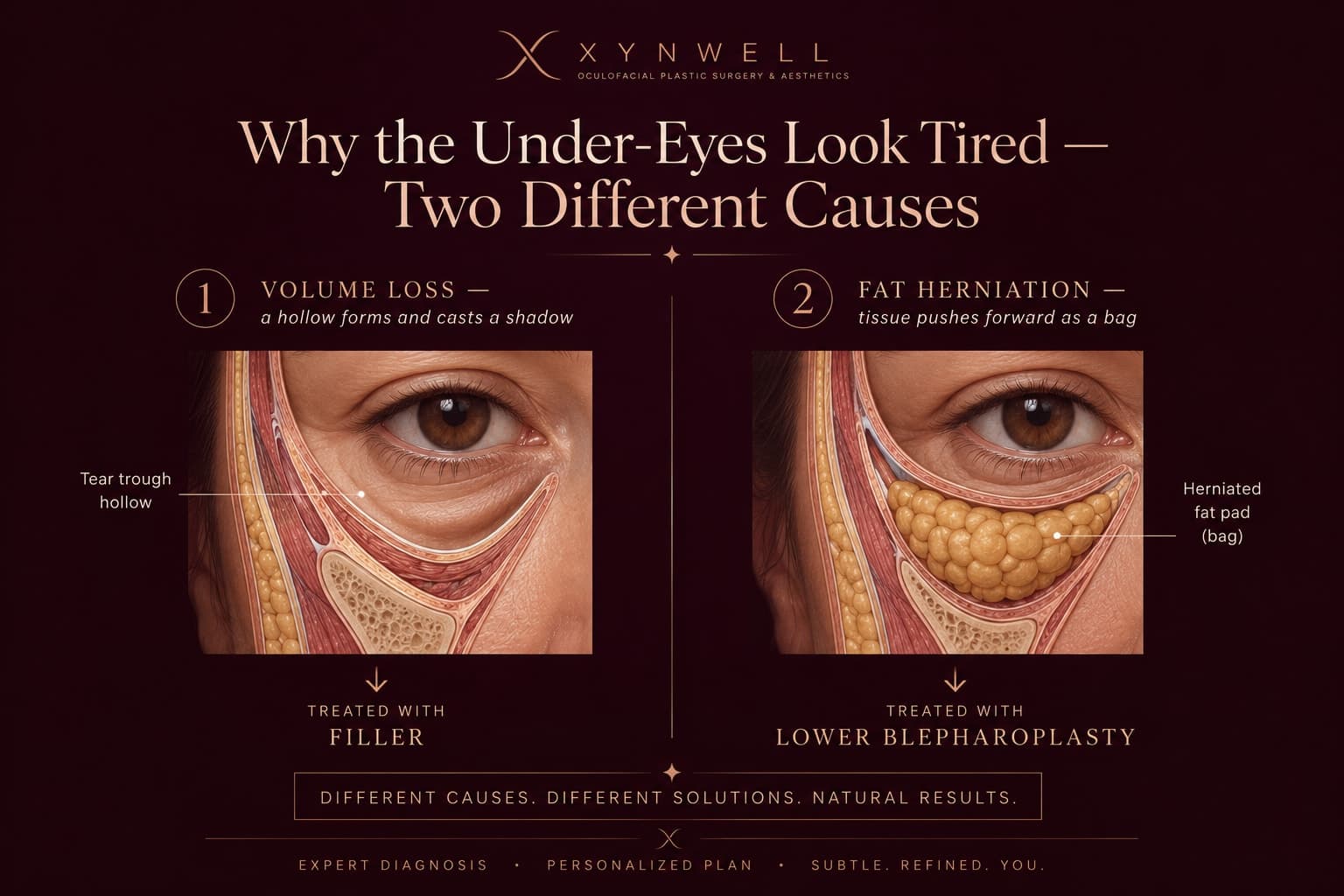
When tear trough filler is the better choice
Tear trough filler is designed to restore volume beneath the eyes.
As we age, volume naturally decreases beneath the lower eyelid, creating a hollow that casts a shadow. This shadow often makes the under-eyes appear dark or tired even when you're well rested.
When volume loss is the primary issue, carefully placed hyaluronic acid filler can soften the transition between the eyelid and cheek, reducing shadowing and creating a brighter, more refreshed appearance.
Tear trough filler is generally best for:
- Under-eye hollowing
- Volume loss
- Mild shadowing
- Minimal puffiness
- Good skin quality
- Patients seeking a non-surgical treatment
When lower blepharoplasty is the better choice
Lower blepharoplasty addresses a different problem altogether.
Rather than replacing lost volume, surgery corrects structural changes that occur as the tissues supporting the lower eyelid weaken over time. Fat beneath the eye gradually becomes more prominent, creating persistent bags that remain visible regardless of sleep, hydration, or skincare.
Because the issue is excess or displaced tissue—not volume loss—adding filler often makes these bags appear more prominent rather than less.
Lower blepharoplasty is generally best for:
- Persistent under-eye bags
- Fat herniation
- Excess lower eyelid skin
- Moderate to severe structural aging
- Patients seeking a long-lasting correction
Can someone benefit from both?
Yes. Many patients have a combination of volume loss and structural aging. In these situations, lower blepharoplasty may correct the underlying eye bags while filler—or fat repositioning performed during surgery—refines the remaining lid-cheek transition.
Treatment is individualized because no two under-eyes age in exactly the same way.
Comparison
| At a glance | Tear Trough Filler | Lower Blepharoplasty |
|---|---|---|
| Primary concern | Volume loss | Eye bags / fat herniation |
| Treatment | Restores volume | Repositions or removes fat |
| Downtime | Minimal | Approximately 10–14 days |
| Longevity | Temporary | Long-lasting |
| Reversible | Yes | No |
| Best for | Hollowing and shadows | Structural under-eye bags |
Which treatment is right for you?
The most important decision isn't choosing filler or surgery. It's understanding why the under-eye looks tired.
Volume loss, eye bags, skin laxity, pigmentation, and facial anatomy all contribute differently to the aging process. The treatment that creates the most natural result is the one that addresses the underlying cause rather than simply masking its appearance.
Frequently asked questions
Can I have filler if I also have under-eye bags?
Sometimes. Mild bags with associated hollowing may still benefit from filler, but significant fat herniation often requires surgery for the most natural result.
How long does tear trough filler last?
Most patients enjoy improvement for approximately 6 months to 2 years, depending on the product used and individual metabolism.
What is recovery like after lower blepharoplasty?
Most bruising and swelling improve over approximately 10–14 days, with continued refinement over the following months.
Can filler and surgery be combined?
Yes. Some patients achieve the best result by combining surgical correction with subtle volume restoration, depending on their anatomy.

Schedule a Consultation
Anatomy decides — not age, and not preference.
Whether your concerns are caused by volume loss, structural eye bags, or a combination of both, every consultation begins with understanding the anatomy behind your under-eye appearance so the treatment recommendation is tailored specifically to you. Xynwell welcomes patients from Scottsdale, Paradise Valley, Phoenix, Arcadia, Fountain Hills, and throughout the Valley.