

Journal · Patient Education
Am I a Candidate for Lower Blepharoplasty? What the Evaluation Actually Looks For
Persistent under-eye fullness is one of the most common reasons patients arrive at a consultation asking whether surgery is the right answer — and one of the most nuanced to evaluate. Lower blepharoplasty at Xynwell is a surgeon-performed lower-eyelid procedure for patients in Scottsdale, Paradise Valley, and the greater Valley, performed by Dr. Ami Shah, a fellowship-trained, ABO board-certified oculofacial plastic surgeon. Candidacy is not a checklist. It begins with understanding what is actually creating the fullness — because anatomy, not age or preference, determines which plan addresses it.
What actually causes under-eye bags?
The lower eyelid is a layered structure: skin, muscle, the orbital septum, and orbital fat all working together. When the structures that support orbital fat begin to weaken — a process that happens gradually and is influenced by anatomy as much as age — fat that normally sits behind the eye can shift forward and become visible as a soft, persistent fullness beneath the eye. This is lower blepharoplasty territory: true fat prolapse, visible regardless of sleep or hydration, that does not respond to topical treatments.
A hollow in the tear trough can look similar from across a room. In a tear-trough hollow, volume loss along the tear-trough ligament and in the surrounding soft tissue creates a shadow and depression that reads as darkness or puffiness — but the mechanism is different, and so is the treatment. This distinction is covered in detail in our companion article on tear trough versus lower blepharoplasty; the short version is that filler placed over true fat prolapse can make bags appear more prominent, not less.
Q: What causes under-eye bags that won't go away with sleep or skincare?
Persistent under-eye bags are most often caused by herniated orbital fat that has shifted forward as the eyelid's supporting structures weaken, and do not respond to rest or skincare.
In practice, the two look-alikes — fat prolapse and tear-trough hollowing — can coexist, and one can mask the other. That is why a specialist evaluation focuses on examining the lower-eyelid structure, the fat compartments, the tear-trough ligament, and how the eyelid behaves under different light and gaze positions. A photograph cannot make this determination; an in-person assessment by a specialist trained in the periorbital anatomy does.
How is lower blepharoplasty candidacy evaluated?
Candidacy for lower blepharoplasty involves more than confirming that fullness is present. A thorough lower-eyelid evaluation considers the lower-lid position and tone, the degree of fat prolapse across the fat compartments, the relationship between the lower lid and the cheek, tear-film health, and overall facial anatomy.
Lower-lid tone — how much support the eyelid has — matters significantly. A lower lid with good tone supports surgical intervention well. A lid with reduced tone (sometimes described as lower-lid laxity) may require additional steps to achieve a stable, natural result. These are details that determine not only whether surgery is appropriate, but which surgical approach fits the individual eyelid.
Q: Am I a candidate for lower blepharoplasty?
Lower blepharoplasty may be appropriate when persistent under-eye fullness is caused by true orbital fat prolapse, the lower lid has adequate tone, and contributing anatomy has been evaluated in person.
In Dr. Shah's practice at Xynwell, the consultation precedes any plan — including the question of whether surgery is the right plan at all. Some patients arrive expecting surgery and leave with a different option; others arrive unsure and find that surgery is well-suited to their anatomy. The evaluation determines the answer, not the assumption a patient brings into the room.
What are the two surgical approaches?
Lower blepharoplasty is performed through one of two incision locations, and the choice is anatomy-driven.
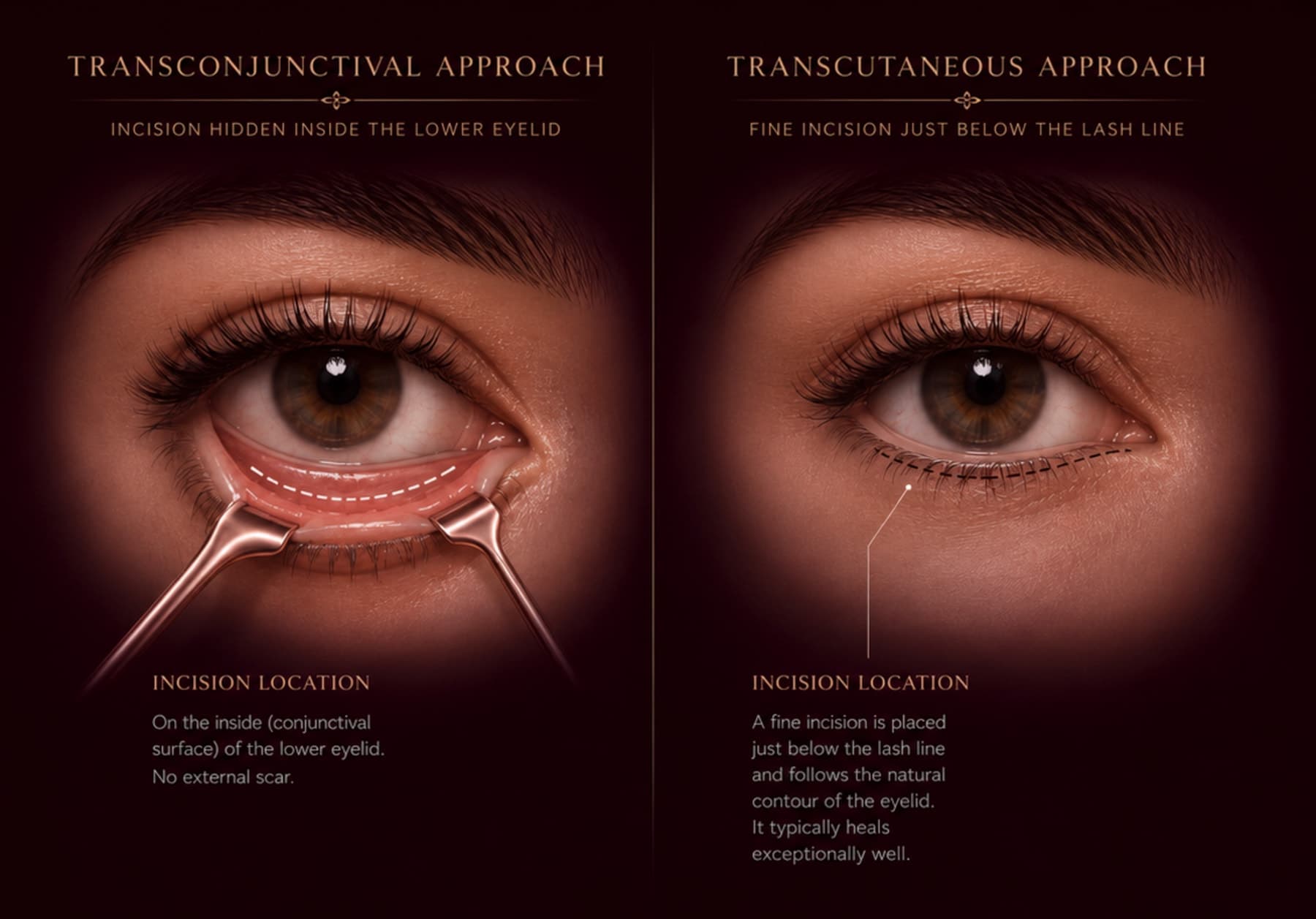

Inside the lower eyelid (transconjunctival approach)
The incision is placed on the inner surface of the lower eyelid, leaving no external scar. This approach accesses the orbital fat without cutting through the skin and is often appropriate when the primary concern is fat prolapse in a patient with good skin quality.
Just below the lash line (transcutaneous approach)
The incision is placed just beneath the lower lashes, where it typically heals as a fine line. This approach allows access to skin as well as fat — relevant when excess skin is also a factor in the lower eyelid's appearance.
Q: What is the difference between transconjunctival and transcutaneous lower blepharoplasty?
Transconjunctival lower blepharoplasty places the incision inside the lower eyelid, leaving no external scar; transcutaneous places it just below the lash line when skin is also addressed.
The incision approach is one of the first things Dr. Shah discusses after examining the lower eyelid, because it shapes the recovery pattern and the surgical goal. Neither approach is universally superior — the one that fits the anatomy is the right one.
What should I expect during lower blepharoplasty recovery?
Honest recovery expectations are part of every lower blepharoplasty consultation at Xynwell. The typical pattern: visible swelling and bruising are present in the first week and gradually resolve, with most patients comfortable returning to public-facing activities within 10 to 14 days. This is a general range, not a guarantee; individual healing varies based on the surgical approach, eyelid anatomy, and the body's own response.
Q: How long does recovery from lower blepharoplasty take?
Most lower blepharoplasty patients are comfortable resuming public-facing activities within 10 to 14 days, as swelling and bruising subside. Full refinement of the result continues over weeks to months.
A few details worth understanding: residual lower-eyelid swelling clears gradually rather than all at once, which is why the initial result at two weeks looks meaningfully different from the refined result at three months. In consultation at Xynwell, specific activity restrictions, return-to-work timing, and what to watch for during healing are reviewed in detail before surgery, so patients have a clear picture before they commit.
What if surgery is not the right plan?
Not every patient who arrives asking about lower blepharoplasty is best served by surgery — and at Xynwell, that determination is made openly. When the predominant issue is tear-trough hollowing rather than fat prolapse, volume replacement with a carefully placed hyaluronic acid filler may address the concern without surgery. When skin quality is the primary issue and fat prolapse is not significant, other approaches may be more appropriate.
The evaluation exists precisely to answer this question. Where the anatomy points to surgery, surgery is recommended. Where it does not, a different plan is explained clearly — including the reasoning.
Frequently asked questions
Do I need lower blepharoplasty or filler for under-eye bags?
The answer depends on what is creating the bags. True fat prolapse — orbital fat that has herniated forward — typically calls for a surgical approach; filler placed over fat prolapse can make bags appear more prominent. A hollow from volume loss in the tear trough may respond well to filler. An in-person evaluation distinguishes the two. For a detailed comparison, see our article on tear trough versus lower blepharoplasty.
What is transconjunctival lower blepharoplasty?
Transconjunctival lower blepharoplasty places the surgical incision on the inner surface of the lower eyelid, accessing the orbital fat without an external incision. It is appropriate when fat prolapse is the primary concern and skin quality is good.
How long does lower blepharoplasty recovery take?
Most patients are comfortable resuming public-facing activities within 10 to 14 days as swelling and bruising resolve. Full refinement of the result — as residual swelling clears completely — continues over weeks to months. Individual healing varies.
Is lower blepharoplasty permanent?
Lower blepharoplasty repositions or conservatively removes the orbital fat that has herniated forward. Skin and soft tissue continue to age, so the result is long-lasting but not a permanent stop to the aging process. These details are discussed at consultation.
How much does lower blepharoplasty cost?
Xynwell is a cash-pay practice and does not bill insurance. Pricing is individualized to each surgical plan and provided during consultation; Xynwell does not publish procedure prices.
Who performs lower blepharoplasty at Xynwell?
Lower blepharoplasty at Xynwell is performed by Dr. Ami Shah, a fellowship-trained, ABO board-certified oculofacial plastic surgeon — Vanderbilt and Stanford trained, formerly of Mayo Clinic Arizona. Xynwell serves Scottsdale, Paradise Valley, and the greater Valley by appointment.
Begin with a Conversation
Xynwell offers private, unhurried consultations for patients in Scottsdale, Paradise Valley, and the greater Valley. Where art meets science, a lower-eyelid plan starts with your anatomy — an individualized evaluation designed to identify what is creating the fullness and reveal the most confident version of you.