

Journal · Patient Education
Do I Need an Upper Blepharoplasty? Three Look-Alike Causes of Heavy Upper Eyelids
Heavy, hooded-looking upper eyelids are among the most common reasons patients ask about eyelid surgery — and easy to misread. Upper blepharoplasty at Xynwell is a surgeon-performed upper-eyelid procedure for patients in Scottsdale, Paradise Valley, and the greater Valley, performed by Dr. Ami Shah, a fellowship-trained, ABO board-certified oculofacial plastic surgeon. And the honest answer to “do I need one?” is: it depends on what is actually causing the heaviness. Similar-looking heaviness can come from excess skin, true eyelid droop (ptosis), a low brow — or a combination of all three. Each calls for a different plan.
Why do my upper eyelids look heavy or hooded?
The upper eyelid is not a single structure. Skin, muscle, fat, the eyelid crease, and the brow all shape how the upper lid looks, and they have to be read together. When the eye area starts to look heavy or hooded, three different anatomic changes can produce a nearly identical appearance: excess upper-eyelid skin, a low eyelid margin (ptosis), and brow descent.
That distinction matters because upper blepharoplasty treats excess upper-eyelid skin — but not every cause of heaviness. Removing skin from an eyelid whose real problem is a drooping margin or a descended brow does not address the underlying anatomy. That is why thoughtful upper-eyelid surgery starts with a diagnosis, not simply a skin measurement.
Q: Do I need an upper blepharoplasty?
Upper blepharoplasty may help if excess upper-eyelid skin is the actual problem. Heaviness caused by ptosis or brow descent calls for different treatment, so an individualized diagnosis comes first.
In Dr. Shah's practice at Xynwell, that diagnosis is the first step of every upper-eyelid consultation. Because the three causes can look nearly identical in the mirror — and often coexist — no checklist or photograph replaces an in-person evaluation of the eyelid, brow, and surrounding anatomy. The question is never only how much skin is present, but which structures are creating the appearance and which plan actually addresses them.
How can I tell whether it is excess skin, ptosis, or a low brow?
Each look-alike involves a different structure:
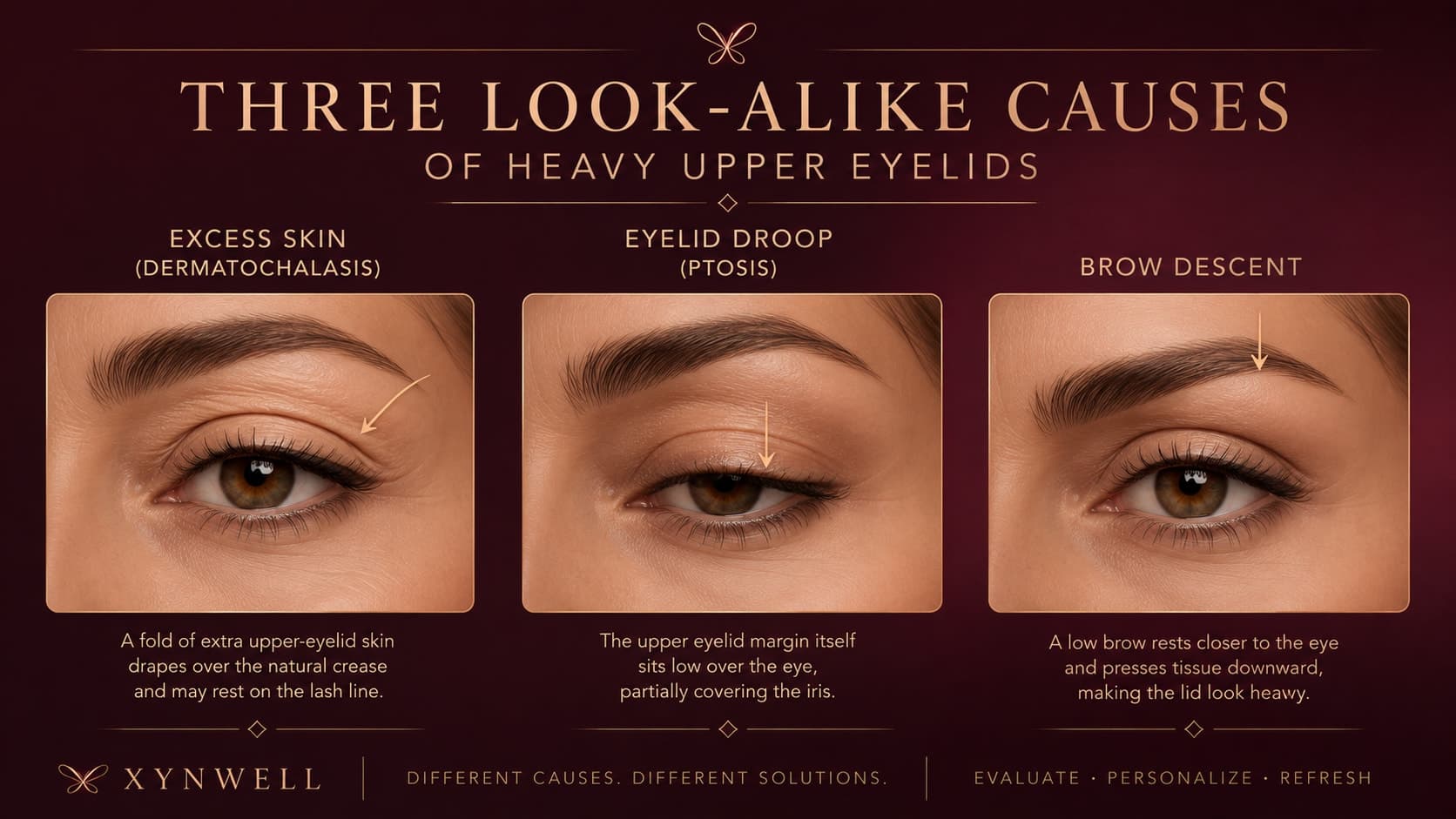

Excess upper-eyelid skin (dermatochalasis)
Over time, upper-eyelid skin can stretch and fold over the natural crease — sometimes far enough to rest near the lash line — while the eyelid margin itself remains in a normal position. This is the problem upper blepharoplasty is designed to treat.
True eyelid droop (ptosis)
In ptosis, the eyelid margin — the edge where the lashes sit — rides lower than it should because of the lid's lifting mechanism, not because of extra skin. Removing skin does not change where the margin sits.
Brow descent
When the brow sits lower, it presses the tissue above the eye downward and can create hooding even when the eyelid skin and margin are normal. Here the brow, not the eyelid, is the driver.
Any of these can also occur in combination, which is common and changes the plan again.
Q: How do I know if I have ptosis or just extra eyelid skin?
Only an in-person examination can reliably distinguish them: in ptosis the eyelid margin itself sits low, while excess skin is a fold resting over a normally positioned eyelid.
Medical references treat dermatochalasis and blepharoptosis as distinct diagnoses with distinct treatments. In practice, they are separated by examination findings — where the eyelid margin sits relative to the pupil, how the brow behaves when the forehead relaxes, and how the skin folds over the crease. These are details a specialist measures rather than estimates from a photograph, which is why self-diagnosis from a mirror or selfie is unreliable.
What does an upper-eyelid consultation at Xynwell evaluate?
An upper-eyelid consultation at Xynwell assesses eyelid position, brow position, tear film, skin quality, and overall facial anatomy — before any treatment is recommended. Different causes call for different plans, and the consultation exists to identify the cause first.
This is where subspecialty training matters. Oculofacial plastic surgery is fellowship training devoted specifically to the eyelids and the structures around the eye — an anatomic territory where millimeters matter — rather than the broader scope of general or facial plastic surgery. Dr. Ami Shah is a fellowship-trained, ABO board-certified oculofacial plastic surgeon: Vanderbilt and Stanford trained, formerly of Mayo Clinic Arizona, with more than 15 years focused on the eyes, eyelids, brows, and face.
What does upper blepharoplasty actually involve?
Q: What does upper blepharoplasty do?
Upper blepharoplasty removes excess upper-eyelid skin and, when appropriate, conservatively manages muscle or fat — through an incision placed within the natural upper-eyelid crease.
When blepharoplasty is appropriate, the goal is not to remove the most tissue. It is to treat what is contributing to the heaviness while preserving the structures that create a natural eyelid. In Dr. Shah's practice, muscle and fat are managed conservatively to preserve natural anatomy and avoid a hollow appearance. The incision is placed within the natural upper-eyelid crease, where it typically heals as a fine, inconspicuous line. Medical references describe blepharoplasty in similar terms: a procedure planned around the individual eyelid's anatomy rather than a fixed amount of skin removal.
What if excess skin is not the only cause?
For some patients, upper blepharoplasty alone is the right treatment. Others may also benefit from ptosis repair, a brow lift, or a combined approach. A careful consultation determines which structures are contributing and in what proportion — and the plan follows the anatomy, from the eyelid and brow to skin quality and facial balance.
This is also why “do I need an upper blepharoplasty?” is a better question to bring to a specialist than to answer alone. The procedure is effective at what it treats. The evaluation exists to confirm that what it treats is what you have.
Frequently asked questions
Is upper blepharoplasty the same as ptosis repair?
No. Upper blepharoplasty addresses excess upper-eyelid skin, while ptosis repair addresses the position of the eyelid margin itself. They treat different structures, and some patients benefit from a combined approach — a determination made at consultation.
Will upper blepharoplasty leave a visible scar?
The incision is placed within the natural upper-eyelid crease, where it typically heals as a fine, inconspicuous line. Individual healing varies, which is one reason candidacy and expectations are reviewed at consultation.
How much does upper blepharoplasty cost?
Xynwell is a cash-pay practice and does not bill insurance. Pricing is individualized to each surgical plan and provided during consultation; Xynwell does not publish procedure prices.
Can a low brow make my upper eyelids look heavy?
Yes. When the brow descends, it pushes the tissue above the eye downward and can create hooding even when the eyelid itself is normal. Treating eyelid skin alone would not address that cause, which is why brow position is part of every upper-eyelid evaluation at Xynwell.
Who performs upper blepharoplasty at Xynwell?
Upper blepharoplasty at Xynwell is performed by Dr. Ami Shah, a fellowship-trained, ABO board-certified oculofacial plastic surgeon — Vanderbilt and Stanford trained, formerly of Mayo Clinic Arizona, with more than 15 years focused on the eyes, eyelids, brows, and face. Xynwell serves Scottsdale, Paradise Valley, and the greater Valley by appointment.
Begin with a Conversation
Xynwell offers private, unhurried consultations for patients in Scottsdale, Paradise Valley, and the greater Valley. Where art meets science, an upper-eyelid plan starts with your anatomy — a personalized evaluation designed to identify the cause of the heaviness and reveal the most confident version of you.